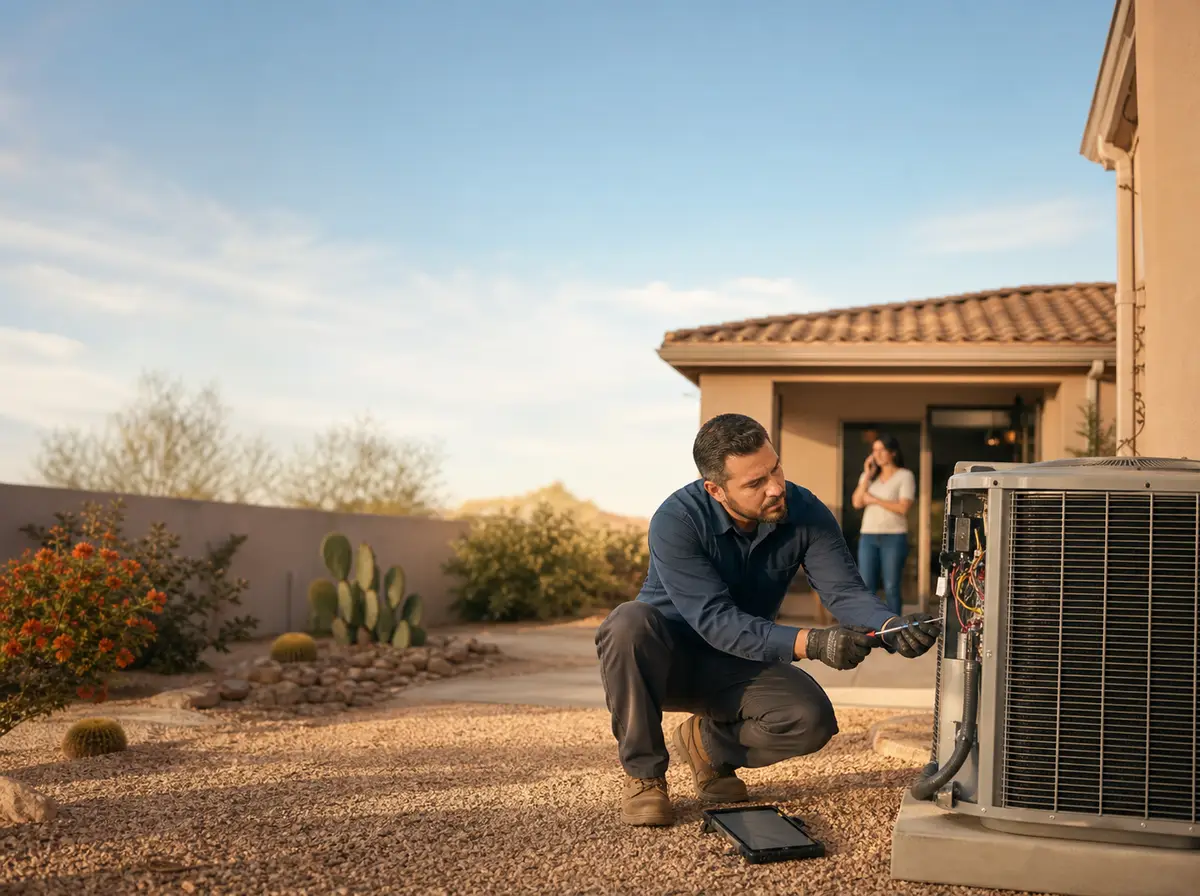
It is 108 degrees in Phoenix and a homeowner's AC just quit. She pulls up three HVAC companies on her phone and calls them in order. The first one rings out to voicemail in English. The second answers in English, she asks in Spanish if anyone speaks Spanish, and the dispatcher says “let me see if someone's around” before putting her on hold. She hangs up. The third company answers her in Spanish, takes her address, and puts a tech on her calendar for 4pm.
She never thinks about the first two companies again. Neither company knows they lost her.
The short answer: an HVAC company can answer Spanish-language calls by putting a bilingual layer on the phone line that greets every caller, recognizes which language they are speaking, and carries the entire call through in that language, including booking the appointment. There are three realistic ways to do it: hire a bilingual dispatcher, use a bilingual answering service, or run a bilingual AI receptionist in front of your existing line. Which one fits depends on your call volume, your after-hours coverage, and how much of your service area speaks Spanish at home.
The rest of this page is about how to size that last question, what the missed calls are actually costing you, and what a good bilingual call handoff looks like on a real service call.
How much of your service area actually speaks Spanish at home?
Nationally, the Census Bureau's American Community Survey counted more than 41 million people speaking Spanish at home, about 13 percent of the US population age five and older. Across all languages, about 8 percent of that same population speaks English less than “very well,” and that is the group most likely to hang up on an English-only greeting.
Those national numbers are close to useless for your business. What matters is your service area, and in HVAC markets across Texas, California, Arizona, Nevada, New Mexico, and South Florida, individual zip codes run several times the national rate. Two companies twenty minutes apart can have completely different call mixes.
Three ways to find your own number in an afternoon:
- Pull the last 90 days of call recordings and count hangups under 20 seconds. Those short drops are your best proxy for callers who could not use the greeting they heard.
- Look up the ACS language tables for the zip codes you actually run trucks in, not your metro as a whole.
- Ask your senior techs. The crew in the field knows which neighborhoods they speak Spanish in all day, even when the office phone never hears from them.
If the answer comes back at 10 percent or higher, you have a revenue problem sitting in your phone system.
What happens when a Spanish-speaking homeowner reaches an English-only line
There are three outcomes, and all three cost you money.
They hang up in seconds and call the next company. This is the most common one and the most expensive, because you get no record of it. It looks identical to a wrong number in your call log.
They push through the call and details get lost. The homeowner has enough English to get the appointment booked, but the address gets garbled, the equipment is described wrong, or the urgency does not come across. Your tech rolls up to a heat pump when the ticket said furnace, or shows up tomorrow on a call that should have been an emergency. That is a wasted truck roll plus an unhappy customer.
They wait for a bilingual family member to call for them. Usually that means the call comes in at 8 or 9pm, after a son or daughter gets home from work. If your line goes to voicemail at 5pm, that call never reaches you at all.
Notice that the after-hours problem and the language problem stack on top of each other. The households most likely to need a bilingual conversation are often the households calling outside business hours, because whoever makes the calls is working during the day too.
What are those missed calls worth? A worked example
Run the math on a mid-sized residential HVAC company:
- 400 inbound calls per month
- 12 percent of callers prefer Spanish, so 48 calls
- On English calls you book about 40 percent
- On Spanish calls you book about 10 percent, because most of them do not survive the greeting
That gap is roughly 14 booked jobs per month walking out the door. At a $450 average repair ticket, that is about $6,300 a month in service revenue you are not capturing.
Then add the replacements. If one in eight of those service calls turns into a system replacement at $9,000 installed, that is another $15,000 a month. Even if you cut every one of these assumptions in half, you are looking at well over $100,000 a year in work going to whichever competitor answered the phone in Spanish.
Now put that against the cost of covering it. A bilingual dispatcher is a salaried hire covering one shift. A bilingual answering service runs per minute and adds up fast during a heat wave. A bilingual AI receptionist typically runs a flat monthly rate and covers every hour of every day. The payback question answers itself pretty quickly once you have counted the calls.
How does an AI receptionist handle a Spanish-language HVAC call?
Here is the actual flow, because this is where most explanations stay vague.
The homeowner calls. Sol answers and greets in both English and Spanish. The homeowner responds in Spanish, and the rest of the call runs in Spanish without her having to press a number or ask for anything.
From there it captures what dispatch needs: name, service address, phone number, whether she is an existing customer, what system she has, what it is doing, and how long it has been doing it. It asks the triage questions your dispatchers ask, including the ones that determine urgency. No cooling at all, in a heat advisory, with an infant or an elderly person in the house is a different call than a unit that is running but noisy, and it should be routed differently.
If it is a bookable service call, it books directly into your dispatch calendar in an open window and confirms the time with her out loud. If it is an emergency, it escalates to your on-call tech and tells her someone is calling her back. Then she gets a confirmation text in Spanish with the appointment window.
Here is the part most companies do not think about: the ticket lands in your system in English. Your dispatcher reads the summary, your tech reads the notes on the way out, and nobody on your team has to speak a word of Spanish for the job to run. The bilingual part is contained to the conversation with the customer, which is the only place it was ever needed.
Is a bilingual answering service better than a bilingual AI receptionist?
Honest comparison, because they solve slightly different problems.
A bilingual dispatcher on staff is the best option for complicated calls. A good CSR reads tone, handles an upset customer, and knows your equipment and your techs. The limits are structural: one person covers one shift, they take vacation, and they cannot be on two calls at once. During a July surge, one person is not enough no matter how good they are.
A bilingual answering service gives you real humans around the clock. The tradeoffs are per-minute pricing that spikes exactly when your call volume spikes, hold times during those same surges, and agents who do not know your dispatch calendar. Most of them take a message and pass it along, which means the customer still waits for a callback.
A bilingual AI receptionist answers every call on the first ring, at 2am and during a heat wave alike, and books straight into your calendar instead of taking a message. The honest limitation is that it needs a clear escalation path. Anything unusual, angry, or outside its scope has to reach a human fast and cleanly.
The right setup is layered, not either-or. Your bilingual CSR handles the calls that need judgment. Sol picks up everything else: the overflow when all your lines are ringing, the 9pm call, the Sunday call, and the second and third simultaneous callers your team physically cannot get to. Sol backs up your front desk, it does not replace anyone on it.
What should a good bilingual AI receptionist do on an HVAC call?
Use this as your evaluation checklist:
- Greet in English and Spanish and switch based on what the caller speaks, with no menu and no button to press
- Handle real Spanish, not translated-sounding phrasing, including how homeowners actually describe equipment problems
- Run your triage questions and correctly separate emergencies from routine service
- Book into your live dispatch calendar with real availability, not a callback request
- Capture and confirm the service address accurately, including spelling it back
- Send the customer a confirmation text in their language
- Write the ticket and internal notes in English for your dispatcher and techs
- Escalate to your on-call human on defined triggers, and tell the customer that is happening
If a vendor cannot demo all eight of those on a live call, keep looking.
Won't customers be annoyed talking to an AI?
Some will. That is a fair objection and worth answering directly.
But compare it to what actually happens today, because the alternative is not a friendly human dispatcher. The alternative is voicemail, a phone that rings twelve times, or a hold queue. For a Spanish-speaking caller, the alternative is a conversation in a language she cannot use to describe the problem with her furnace.
In practice, what irritates callers is not the AI. It is an AI that cannot do anything, that loops, or that will not let them reach a person. An agent that answers on the first ring, speaks their language, gets their appointment booked in 90 seconds, and hands off to a human the moment the call needs one is a better experience than what most HVAC companies offer at 8pm on a Saturday.
How do you roll this out without disrupting dispatch?
Start narrow and expand once you trust it.
Turn it on for after-hours and weekends only for the first two weeks. Nothing changes during business hours, and your team keeps working exactly as they do now. Connect it to your existing stack so bookings land where your dispatcher already looks, whether that is ServiceTitan, Housecall Pro, Jobber, or your own calendar. Then read every transcript for those two weeks, fix the answers that came out wrong, and tighten the escalation triggers.
Once after-hours is clean, add daytime overflow, so calls that would have gone to hold get answered instead. Most companies find the overflow calls are worth more than the after-hours ones, because that is where the surge revenue lives.
Answer every call, in the language the caller uses
Sol is a bilingual AI receptionist built for businesses that run on the phone. It answers in English or Spanish, 24 hours a day, captures the details dispatch needs, books the job into your calendar, and hands off to your on-call human when the call needs a person. Your team gets the notes in English. Your customer gets answered in their language. Nobody on your staff gets replaced.