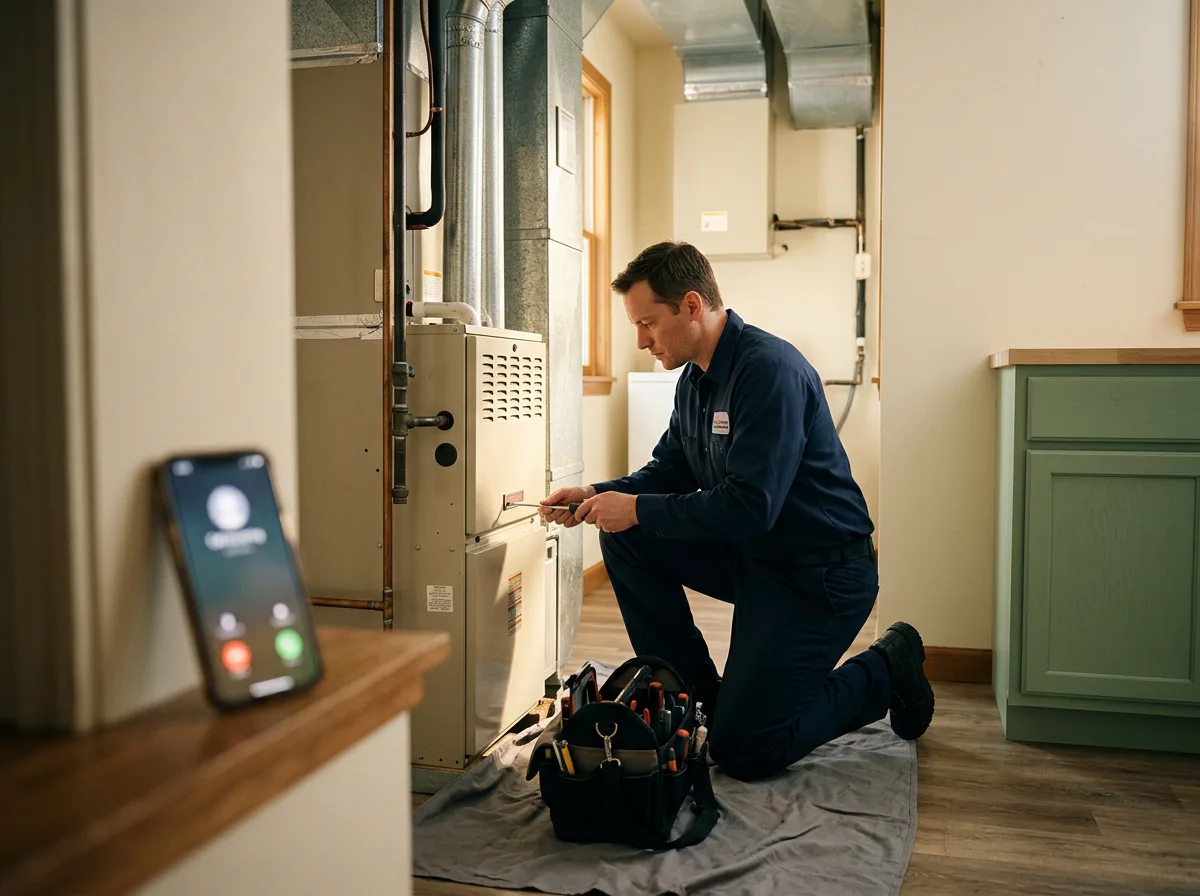
A homeowner’s AC quits on the first hot Saturday of the summer. They do not research contractors. They grab their phone, call the first HVAC company that comes up, and if no one answers, they call the next one. The job goes to whoever picks up. Not the best company. Not the cheapest. The one that answered.
That is the uncomfortable truth about running an HVAC business on the phone. Roughly 78% of homeowners hire the first contractor who responds. Speed beats reputation and price in that first moment of contact. So the real question is not whether your crews are good. It is whether anyone is there to answer when the call comes in.
For most HVAC companies, the honest answer is no. And every unanswered ring is a job walking to a competitor.
Why does the first HVAC company to answer usually win the job?
Because a broken furnace or a dead AC unit is an emergency, and emergencies do not wait. When something stops working, the homeowner wants it fixed today, and they will keep dialing until a human helps them. The first company to answer sets the appointment, and the rest never get a callback.
The data backs this up hard. MIT research found that responding within five minutes makes you 21 times more likely to qualify a lead than waiting 30 minutes. ServiceTitan’s benchmark report found that companies answering within two minutes convert 62% of inbound leads, while the industry average, at a 42-minute response time, converts just 28%. For a contractor running 80 leads a month at a $1,400 average job value, that gap works out to around $381,000 a year.
88% of HVAC contractors take longer than five minutes to respond, and the single most common response time is a full day. Speed is the cheapest competitive advantage in the trade, and almost everyone is leaving it on the table.
How many calls does a typical HVAC business actually miss?
More than owners think, because the misses happen exactly when the business is busiest. When your office is staffed, roughly 27% of HVAC calls still go unanswered. When crews are on site and no one is at the desk, that number jumps to 62%.
The reason is simple. Your best people are the ones on the tools, and they cannot stop mid-repair to answer the phone. So the calls stack up during peak season, on weekends, and after hours, which is exactly when 62% of HVAC calls come in. Furnaces fail at 2 AM. AC units die on Sunday afternoons. That is not the exception. That is the pattern.
And callers do not leave a message and wait patiently. About 85% of people who reach voicemail never call back, and 62% call a competitor instead. A missed call is not a delayed job. It is usually a lost one.
What does a missed HVAC call really cost?
Each missed HVAC call represents somewhere between $350 and $1,200 in lost revenue, depending on the job. Miss five to ten calls a week, which is normal during a heat wave or a cold snap, and you are looking at $45,000 to $120,000 a year gone. Not from bad work or bad reviews. From a phone nobody could get to.
Most owners never see this number because it never shows up on a report. There is no line item for the job you never booked. The loss is invisible, which is exactly why it goes unfixed year after year while the business blames slow seasons or the market.
Put a real figure on it. Take your average ticket, multiply by the calls you miss in a busy week, then multiply by the weeks your season actually runs. The result is almost always larger than any single marketing expense you are worried about. You are spending money to make the phone ring, then letting a chunk of those calls hit voicemail.
How does an AI receptionist handle after-hours HVAC calls?
An AI receptionist answers every call, day or night, on the first ring, and handles the conversation like a trained dispatcher would. It picks up, listens, and works the call to a booked appointment or a dispatched emergency instead of dropping it into voicemail.
For a 2 AM no-heat call, Sol answers, recognizes it as an emergency, collects the address and equipment details, asks the right diagnostic questions, and texts your on-call technician with the full job before the homeowner even hangs up. For a routine tune-up request, it knows the difference and books the appointment into an available window based on your service area and job priorities. It does not put callers on hold, and it does not lose the fifteen other people calling during a heat wave, because it can hold every one of those conversations at the same time.
It also connects to the systems you already run on. A good AI receptionist passes jobs straight into platforms like ServiceTitan, Housecall Pro, and Jobber by SMS, email, or webhook, so the work shows up where your team already looks. And for the growing share of customers who are more comfortable in Spanish, Sol handles the call in English or Spanish without missing a beat, so a language barrier never sends a paying customer to the competitor down the road.
Will an AI receptionist replace my front desk or dispatcher?
No. Sol backs up your team, it does not replace it. Your dispatcher is still the one running the board and making judgment calls during the day. Sol catches what would otherwise slip: the overflow when 30 calls land before 9 AM, the after-hours emergency, the Sunday call while everyone is off, the second and third callers stuck on hold.
Think of it as the coverage you have always needed but could never justify hiring for. You are not paying a night shift to sit by a phone that rings a few times. You are making sure that when it does ring, at any hour, someone answers, captures the job, and gets it to the right person. Your staff stops drowning in missed-call guilt, and your calendar stops leaking revenue.
What should a good HVAC AI receptionist be able to do?
At minimum, it should answer 24/7, triage emergencies against routine requests, collect the details a tech actually needs, book into your real availability, and hand the job to your existing software and on-call staff. Anything less just moves the dropped call somewhere else.
Use this as a checklist. A capable AI receptionist for HVAC should answer every call on the first ring with no hold time, tell a 2 AM furnace failure apart from a next-week tune-up, gather the address, equipment, and problem details, dispatch true emergencies to your on-call tech immediately, schedule non-urgent jobs into open windows by service area, push everything into your dispatch platform automatically, and handle calls in both English and Spanish. If a tool cannot do these, it is an answering machine with extra steps.
The fix is answering, and it is cheaper than the loss
Winning more HVAC jobs does not require a bigger ad budget or a lower price. It requires being the company that answers first, every time, including the nights and weekends when the emergencies actually happen and the competition is asleep.
That is the whole job Sol was built for. It answers every call, books the appointment or dispatches the emergency, works in English and Spanish, and keeps your calendar full without adding headcount. The math is simple: the cost of coverage is a fraction of the $45,000 to $120,000 a year most contractors lose to missed calls.